

AC Synchronous Motor vs DC Gear Motor
Both of these are gear-reduced motors of broadly similar size, both are used in the same kinds of machines, and the comparison between them is usually run as a list of pros and cons. That framing hides the one difference that decides most applications. One motor takes its speed from the wall socket. The other takes its speed from the load. Everything else in the comparison follows from that.
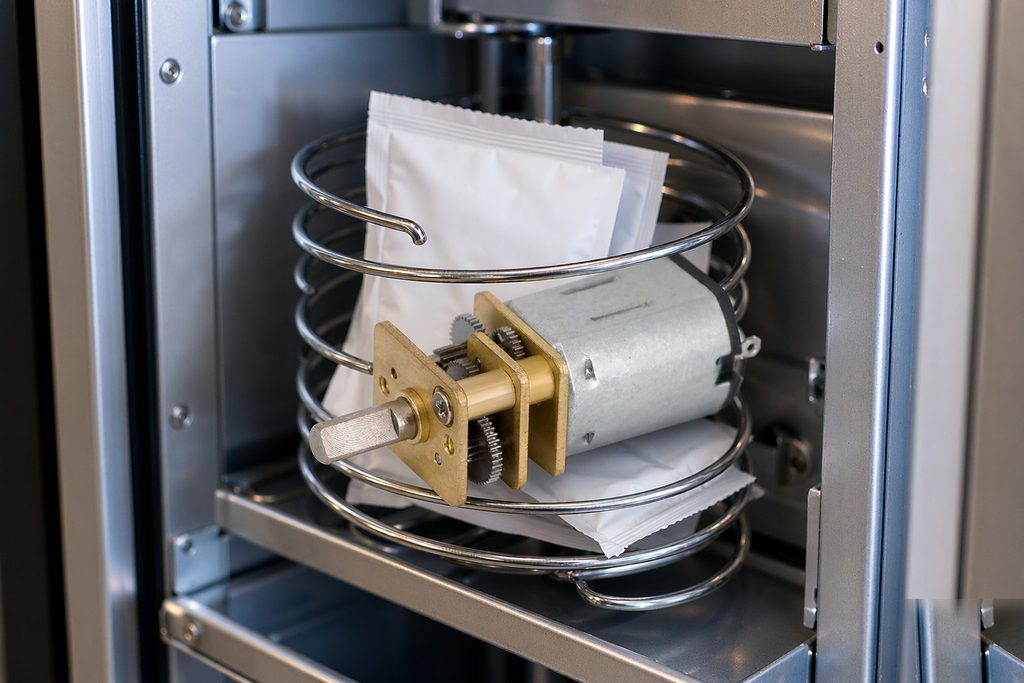
One Speed Comes From the Mains, the Other From the Load
A Synchronous Motor turns at a speed fixed by the supply frequency and the pole count, divided by the gear ratio. The 50KTYZ is quoted at 10 rpm and about 40 kgf·cm at 50 Hz, and that 10 rpm does not change between no load and rated torque. The manufacturer’s own description says it plainly: constant speed, unaffected by voltage. Nothing about the load or the supply voltage moves that number.
A DC gear motor behaves in the opposite way. Its speed sits on a falling line against torque, so the same unit runs slower the moment it is asked to work. This is visible in the published configurations of the ZGB37RG: the 12V version is listed at 60 RPM with no load and 42 RPM at rated torque, and a 24 V version at 30 rpm with no load and 21 RPM rated. Those two differ in both voltage and ratio, and both land on a shortfall of exactly 30 percent, which indicates that the drop belongs to the motor rather than to the gearbox.
So the first question is not which motor is better. It is whether the machine needs a speed that cannot move, or a speed it can adjust.
What a Fixed Speed Buys, and What It Costs
What it buys is repeatability with nothing added. No encoder, no controller, no calibration step at the end of the line. Where the process is defined by a duration, a rotisserie cycle, a valve timer, a screen that must travel at a set rate, the process time becomes a constant of the electricity supply rather than a property of the unit in front of you.
What it costs is choice. The output speed is whatever the ratio and the frequency give, and it cannot be trimmed. Reducing the voltage does not slow the motor, it only reduces its margin, and a load it can no longer carry results in a stall at several times rated current rather than a graceful slowdown. The direction of rotation is settled when the order is placed.
The export consequence is the one that catches people. Frequency sets speed, so a 50 Hz to 60 Hz change is a factor of 1.2, not a small trim. The 50KTYZ at 10 rpm becomes 12 rpm. The A60KTYZ is quoted at 40/48 rpm for exactly this reason, and its 18 W rating is the same in both markets. A machine developed and timed on 50 Hz runs one fifth fast in a 60 Hz market, and the correction is a different gear ratio, not a setting in a controller. A DC gear motor has no equivalent problem: at the same voltage it runs at the same speed wherever it is plugged in.
What an Adjustable Speed Costs
A DC gear motor is variable almost for free. Pulse width modulation gives continuous speed control, the supply can be a battery, and starting torque is generous relative to rated torque. On the ZGB37RG the 12 V version is quoted at 2.0 kgf·cm rated against 3.6 kgf·cm at stall, so a mechanism that starts against friction or a full hopper has margin to break away.
The price is that the 30 percent droop is always present, wanted or not. A machine that needs a repeatable speed from a DC gear motor has to earn it, either with feedback on the output or by operating well below the rated point where the line is flatter. That is a real cost, and it is the mirror image of the synchronous motor’s free repeatability.
There is also the brush. A brushed DC motor’s life is measured in running hours, and in continuous duty the brush becomes the limit before anything else does. A synchronous motor has no brushes and no commutator, so for a machine that runs for hours at a time the maintenance question does not arise. This is the strongest argument for the AC side and it has nothing to do with efficiency.
Where the Comparison Stops Applying
The two families do not actually overlap as much as the catalogues suggest, because the supply decides the answer before the specifications do. An AC synchronous motor needs mains voltage. A ZGA12FT in a smart lock runs from cells, draws very little, starts and stops on command and produces almost no electrical noise. There is no AC synchronous option for that machine at all, not because it is worse but because there is no socket inside a door.
The reverse holds at the other end. A 50 mm or 60 mm AC synchronous gear motor driving a mains appliance at a fixed rate has no DC competitor that is simpler, because the DC version needs a power supply and, if it is to hold speed, a controller as well. Two wires and a gearbox is a difficult package to beat on cost and on certification.
The comparison therefore tends to resolve on one question: is there mains power at the motor, and does the process tolerate a speed that varies with load? Where both answers are yes, the AC motor is the simpler machine. Where either answer is no, the DC gear motor is the only one of the two that can be used, and the discussion moves to ratio and duty instead.

What to Send
Four items settle it. Whether the motor has mains or a battery available, since that removes one of the two options immediately. Whether the process is defined by a fixed rate or needs to be adjustable, which decides between the two behaviours above. The output torque at the required speed, stated together with the tolerance on that speed, because a tolerance of a few percent is only achievable on one of these two. And the markets the machine will be sold in, because a 50 Hz design shipped to a 60 Hz market changes its timing by a fifth unless the ratio is changed with it.


