

How Do You Measure the Actual Rotational Speed of a Motor?
The label says 3,000 RPM. Whether the shaft is really turning that fast is a different question, and it is worth answering before you build a machine around it.
Rated speed is measured under conditions you will probably never reproduce: one specific voltage, one specific load, one specific temperature. Move any of those and the number moves too. A motor rated at 3,000 RPM might read 2,800 on a warm afternoon and 3,100 on a cold morning, and neither reading means anything is wrong.
Here is how to find the actual rotational speed of a motor, what a normal reading looks like, and when a reading should worry you.
If you just need a number today
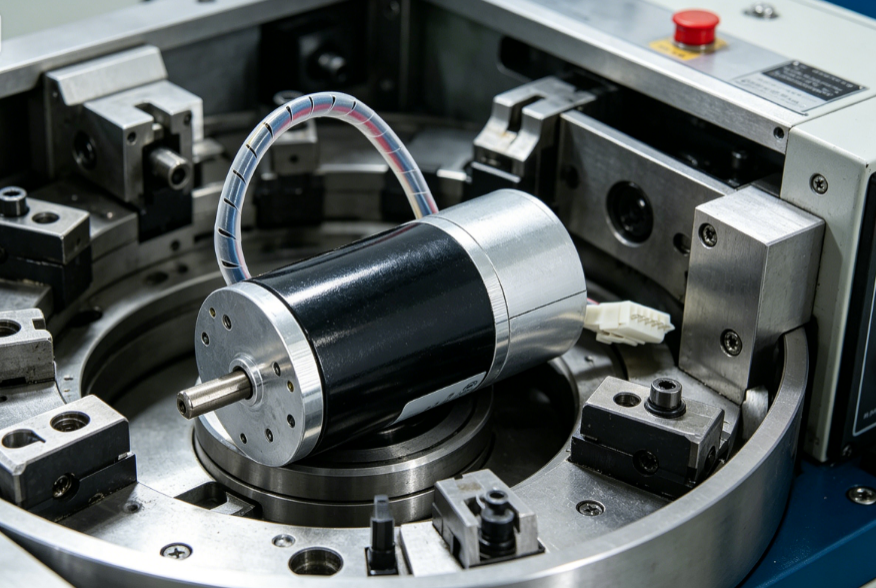
Buy or borrow an optical tachometer. Put one strip of reflective tape on the shaft or coupling, aim the meter at it, read the display. It takes about a minute, costs very little, and works on motors of any size without touching them.
That one tool covers most everyday situations. The rest of this article explains when it is not enough, and what else is worth knowing.
Why the nameplate and the shaft disagree
Four things pull speed away from the rating, and three of them are perfectly normal.
Supply voltage. On a permanent magnet DC motor, speed tracks voltage fairly closely. Feed a 24 V motor 22 V and it will run several percent slow. That is the motor behaving correctly.
Load. Speed drops as you ask for torque. That is what the speed-torque curve describes. A motor rated 3,000 RPM free-running might hold 2,400 RPM at rated load, a 20 percent drop that is entirely by design.
Temperature. Windings heat, resistance rises, and speed drifts as the motor settles into steady state. A reading taken thirty seconds after start-up is not the same as one taken after an hour.
Anything between the motor and the machine. A gearbox, a belt, a coupling, a slipping pulley. If you measure downstream of a gearbox you are reading output speed, not motor speed, and the two differ by the gear ratio.
Understand those four and you already know more than most people who own a tachometer.
Three ways to get a reading
Optical tachometer, non-contact. The everyday workhorse. Reflective tape on the shaft, aim the beam, read RPM. Nothing touches the motor and nothing loads it. One warning: count your tape strips. Two strips make the meter read double, and that mistake has probably fooled more people than any other.
Contact tachometer. A rubber tip pressed against the shaft end or into a centre drilled in it. Direct and reliable on larger motors. On a small motor, remember that the pressure you apply is itself a load, and it will pull the reading down.
Stroboscope. Flash a light at an adjustable rate and watch a mark on the shaft. Raise the rate until the mark appears to stand still, and that rate is your speed. Useful when there is nothing you can attach to, such as a fan or a belt. The catch is harmonics: the mark also stands still at half and at double the true speed, so halve your frequency to confirm which one you found.
Checking a motor you have just received
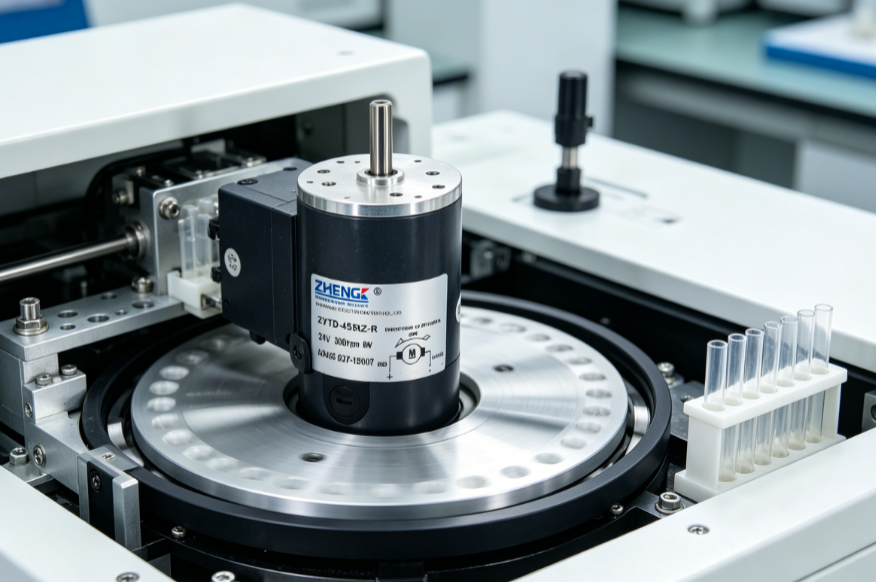
If you buy motors in volume, a five-minute incoming check is a habit worth having. Run the motor at its rated voltage, let it settle for a few minutes, take three readings, and write them down with the supply voltage beside them.
Then compare against the datasheet, and be careful which figure you compare against. Datasheet no-load speed and rated-load speed are different numbers, and a motor that looks slow against the first may be exactly right against the second.
A motor that reads consistently low under no load is the one result that deserves a phone call.
What the number is actually good for
Most machines do not care about shaft RPM. They care about what the shaft drives.
Behind a gearbox, output speed is motor speed divided by the gear ratio, so 3,000 RPM through a 60:1 reducer gives 50 RPM at the output. For a conveyor or a belt, linear speed is π times the pulley diameter times RPM, which is usually the figure printed on the machine specification. On an AC induction motor, the small gap between synchronous speed and measured speed is slip, and it widens as load increases.
What to ask your supplier
A good supplier can tell you how a figure was obtained, not just what it is. Ask whether the speed data is measured or calculated, under what voltage and load it was measured, and what tolerance is normal for that model. The answers tell you a lot about who you are buying from.
The short version
For a quick check, an optical tachometer and one strip of tape will do it. If the reading looks wrong, check the voltage and the load before you blame the motor. And if the machine has to hold its speed day after day, get a motor speed signal the controller can actually see, because a number you measure once is only a snapshot.


