

No images found.
A vending machine dispenser is one of the few mechanisms where the motor does not set the accuracy. The spiral does. Each turn of the auger advances one pitch and releases one product, so the portion is fixed by the geometry of the spring and the spacing of the coils, not by anything the motor controls. That single fact explains most of what follows: the motor does not need an encoder, a position loop or a smart driver, because the mechanical arrangement has already done the measuring. What the motor has to guarantee is narrower and harder, which is that it completes that one turn every time, on the heaviest slot, on the coldest shelf, and after the hundred thousandth start.
The Spiral Decides the Portion, Not the Motor
A dispensing spiral is a wire coil wound on a shaft running down the center of a shelf. Products sit between adjacent coils, and a full revolution of the shaft carries every product in that lane forward by one pitch, dropping the leading item past the lip. One vend equals one turn, and the turn is the unit of measure.
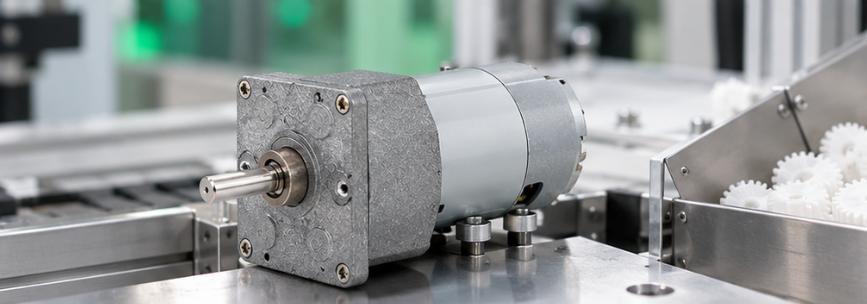
This changes what the motor is being asked for. There is no need to count revolutions, because a partial turn does not half-dispense a product, it simply fails to release one. The board runs the motor long enough to complete a revolution under load, and if nothing drops, a sensor detects the failure rather than shaft position. A ZGB37RG at its rated 42 rpm completes a turn in about 1.4 seconds, and that time, not the speed figure, is what the firmware is written around.
The one place where motor behavior does matter to the dose is at the very start of the turn. The spiral has to break the static friction between product and shelf, and that takes more torque than keeping it moving. A motor with a soft start and weak breakaway torque can stall on the first few degrees, the controller times out, and the machine reports a failure on a slot that was perfectly loaded.
The Worst Slot Sets the Torque, Not the Heaviest
Selection usually starts with the heaviest product, and that is the wrong end of the shelf. A 500 ml bottle weighs about half a kilogram, and pushing it along a plastic lane at a friction coefficient around 0.3 needs roughly 1.5 N of thrust. Through a 30 mm pitch spiral at an efficiency of about 0.3, that works out to roughly 0.024 N·m at the shaft, which is 0.24 kgf·cm. Against the 2.0 kgf·cm rating of a ZGB37RG, normal dispensing uses about one tenth of what the motor can deliver.
The slots that cause trouble are the light, soft ones. A bag of chips weighs thirty grams but deforms under the spiral, and the coil can ride over it, wedge it against the shelf divider, or drag it sideways into the next lane. The resistance is not proportional to weight, and in practice a snack lane can demand more from the motor than a beverage lane. The figure worth designing to is the worst friction in the machine, not the highest mass on the manifest.
Telling a Jam From an Empty Slot
Permanent magnet DC motors have a property that matters more here than their price: current is proportional to torque, with no controller in between to obscure the relationship. An empty lane draws almost nothing, a normal vend draws the running current, and a jam pushes the current towards the stall value. Those three levels are distinguishable, and that is what the machine uses to decide whether to retry, reverse, or flag the lane.
For the three levels to be separable, the gap between running and stall current has to be wide and repeatable. On a ZGB37RG running at 0.4 A and stalling at 0.8 A the ratio is two to one, which is workable but not generous, and it narrows as the motor warms or as the brushes wear. A motor with a flatter current-torque characteristic, or one whose stall current drifts with temperature, turns a simple threshold into a tuning problem for whoever commissions the machine.
The other half of jam handling is thermal. When the spiral seizes, the motor sits at stall current until the controller reacts, and controllers commonly allow one to three seconds before cutting power. That means the motor has to survive repeated stall events of that duration without the winding reaching its insulation limit, which is a different requirement from surviving the normal duty. If a machine jams twice an hour on a badly loaded shelf, the motor sees more thermal stress from the jams than from the vending.
Cold Shelves and the Cost of a Failed Vend
Refrigerated cabinets run near 4 degrees Celsius, and the lubricant in the gearbox thickens at that temperature. Breakaway torque on a cold start can be several times the warm value, and it arrives exactly when the machine has just taken payment and cannot afford to fail. This is the reason a motor that tests well on a bench at room temperature can be unreliable in a beverage machine, and why the temperature at the motor, not the ambient of the room it stands in, belongs on the enquiry.
The economics of a failed vend are worth stating because they set the real reliability target. A dispenser that jams once in two hundred cycles costs the operator a refund, a service call and a customer, and the motor is implicated whether or not it was responsible. That is a harsher standard than a datasheet rating implies, and it is why vending machines use metal gearboxes: not for the average load, which is light, but for the impulse of three hundred starts a day, each of which loads the first gear stage with an acceleration torque the running figures never show.
What Belongs on the Enquiry
Running time is a poor guide here. Three hundred vends a day at two seconds each comes to about ten minutes of running, or sixty hours a year, which suggests a motor that will outlive the cabinet. The same machine accumulates around a hundred and ten thousand starts a year, and each start is what loads the gear train. Duty should therefore be quoted as cycles per day and seconds per cycle, not as a percentage.
Four further figures settle the rest: the thrust needed to move the worst product in the machine, the pitch of the spiral, the temperature inside the cabinet, and the current window the controller uses to distinguish a jam from an empty lane. With those, whether a ZGB37RG or the larger 42 mm ZGA42REE frame is the right starting point becomes arithmetic instead of opinion, and the gearbox material, the breakaway torque and the stall duration can be settled before a prototype is built.
What Motor Does a Vending Machine Dispenser Need?
A vending machine dispenser is one of the few mechanism […]


